

Pioneering the Future of Secure Communication and Data Protection
Inventor: Julio Verissimo | Prepared by: Borderless Consulting – Patented
Building upon the groundbreaking success of Enigma Cypher Encryptor 1.0, which set a global benchmark for data security, Version 2.0 represents a truly futuristic leap in cryptography, its own patented and file format SECBOR, merging classical encryption techniques with state-of-the-art post-quantum algorithms. This next-generation system is designed to secure critical communications, multi-recipient data exchange, and high-value information storage against threats that extend well beyond current technological horizons. Enigma Cypher Encryptor 2.0 is not only an evolution — it is a revolution, setting a new global standard for privacy, confidentiality, and integrity in the digital era.
Comprehensive Protocol Integration
Enigma Cypher Encryptor 2.0 integrates a carefully orchestrated combination of protocols and cryptographic layers, ensuring unparalleled resilience and multi-dimensional protection:
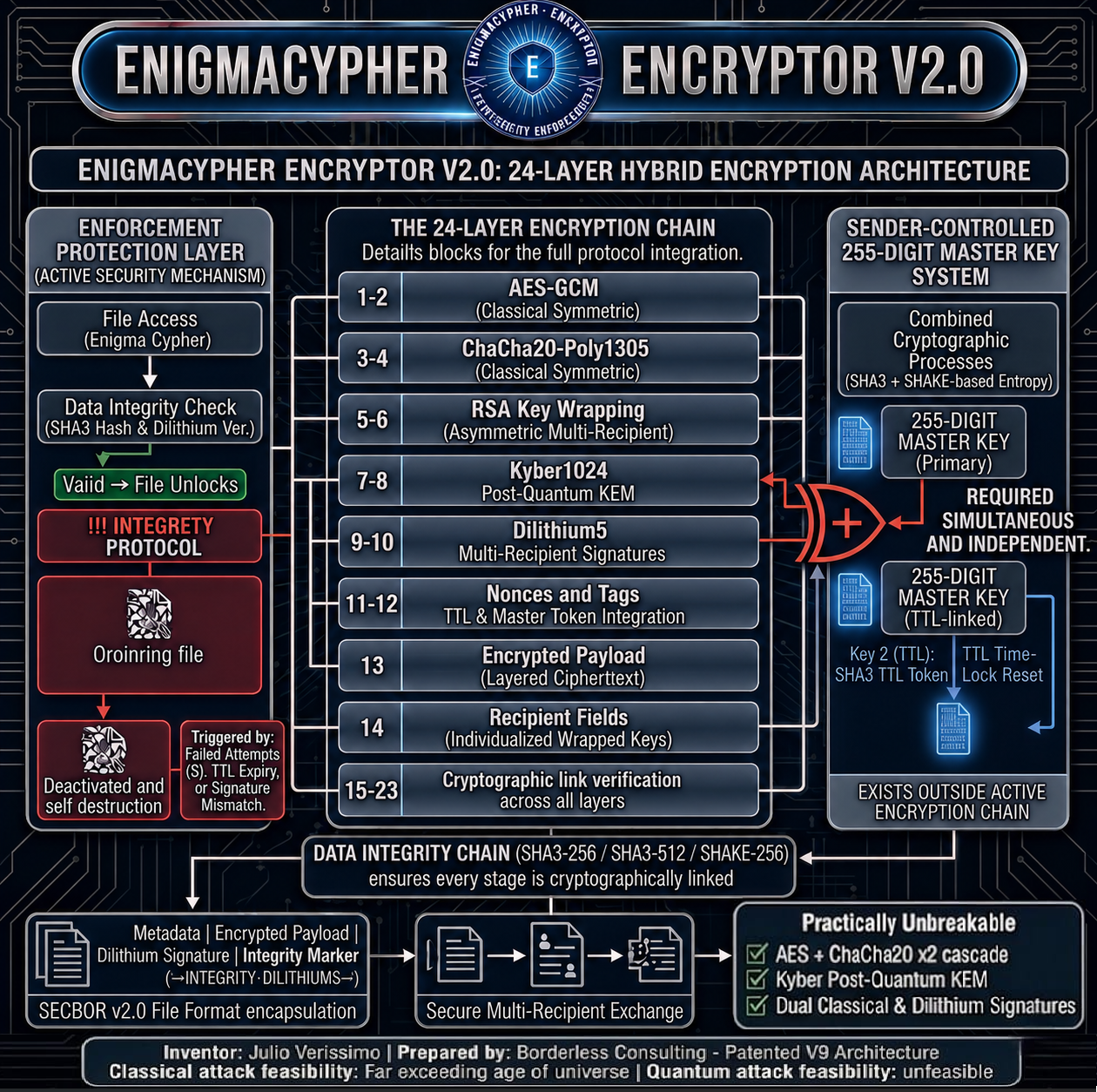
- AES-GCM ×2 layers – high-strength, classical symmetric encryption for foundational security
- ChaCha20-Poly1305 ×2 layers – fast, efficient, and secure symmetric encryption
- RSA Key Wrapping ×2 recipients – secure asymmetric distribution of keys
- Kyber Post-Quantum KEM – fully quantum-resistant key encapsulation
- Dual Signatures (RSA + Dilithium) – classical and post-quantum verification for message authenticity
- Nonces and Tags – cryptographic metadata ensuring integrity and authenticity
- Encrypted Payload – layered ciphertext to protect sensitive content
- Recipient Fields – individualized wrapped keys for secure multi-recipient decryption
All critical layers—AES-GCM ×2, ChaCha20 ×2, RSA key wrapping for multiple recipients, Kyber KEM, and both RSA and Dilithium signatures—must be simultaneously compromised to breach any encrypted message. Non-critical layers, including metadata, nonces, and structural elements of the ciphertext, are inherently resistant to attacks, providing additional security verification and resilience.
24-Layer Hybrid Encryption Architecture with Enforcement Protection Layer and 2x Sender-Controlled 255-Digit Master Key System
Enigma Cypher Encryptor 2.0 is built on a 24-layer diversified asymmetric, symmetric, metric encryption and post-quantum cryptographic architecture, where classical encryption, hybrid key exchange, integrity validation, and post-quantum resistance operate together as a single unified chain. The system integrates Argon2id key derivation, AES-GCM encryption, Kyber post-quantum key encapsulation, Dilithium post-quantum signature verification, and a SHA3-based integrity chain (SHA3-256 / SHA3-512 with SHAKE-256 entropy expansion), ensuring that every stage of encryption is independently secured while remaining cryptographically linked across the full structure.
Above this architecture, an enforcement protection layer governs access control before any decryption process can occur. This layer continuously validates authentication attempts and cryptographic consistency across the full 24-layer structure. If three consecutive invalid authentication attempts are detected, the system immediately transitions the file into a fully locked state, suspending all decryption operations and freezing the encrypted structure at the enforcement level, preventing any key derivation, negotiation, or reconstruction from executing.
Within this security model, 2 x 255-digit Master Key is generated using combined cryptographic processes involving SHA3 and SHAKE-based entropy expansion along with layered cryptographic transformations. This Master Key exists outside the active encryption chain and is exclusively held by the sender. It functions as the only authorized mechanism capable of restoring access once the file has been locked, ensuring full control remains with the original creator and cannot be derived or reconstructed from the encryption system itself.
Impenetrable Security Design
Classical attack feasibility: Attempting to brute-force the symmetric cascade (AES + ChaCha20 ×2) would require approximately 1.16 × 10^77 operations, taking 3.68 × 10^51 years—far exceeding the age of the universe—and consuming energy levels greater than all available in the observable cosmos. Simply put, no classical computational system could realistically overcome this layered defense.
Quantum attack feasibility: Even with Grover’s algorithm, or a hypothetical fault-tolerant large-scale quantum computer, the effective quantum security of AES-256 and ChaCha20 remains formidable at ≈128 bits, while post-quantum protocols Kyber and Dilithium remain entirely resistant. Achieving simultaneous compromise of symmetric, asymmetric, and post-quantum layers is effectively impossible, ensuring that encrypted data remains secure for decades or even centuries to come.
Worst-case cosmic scenario: In an extreme theoretical scenario with unlimited resources, perfect quantum computing, and industrial-scale implementation of Shor’s algorithm, only RSA recipient keys or classical signatures might be compromised. However, the symmetric cascade and post-quantum Kyber layer still fully protect the encrypted payload, making decryption unattainable.
Strategic Assessment and Resilience
- Classical attack cost: exceeds all energy available in the universe
- Quantum attack cost (full system): ≥10^30 years
- Minimum qubits required for RSA break: 20M logical / ~1B physical
- Estimated real-world research lead time: 70–120 years for best-case scenario
- Probability of full system compromise by 2100: <10⁻³⁰
With 24 encryption layers, dual signatures, and post-quantum protection, Enigma Cypher Encryptor 2.0 is practically unbreakable, even when faced with all currently known, planned, or theoretically possible computational technologies.
Commitment to Global Security and Privacy
Enigma Cypher 2.0 is not just a technical marvel—it is a strategic statement of Borderless Consulting’s commitment to safeguarding privacy, advancing secure communications, and creating a safer digital environment worldwide. This system is ideal for:
- Government and military communications requiring the highest security
- Multi-recipient corporate and financial data transmission
- Secure digital archives for critical organizational information
- Confidential messaging and archival storage
By combining military-grade symmetric layers, hybrid asymmetric key wrapping, and post-quantum cryptography, Enigma Cypher 2.0 guarantees integrity, authenticity, and privacy for all authorized recipients, establishing a new paradigm of security in the digital age.
Read Internal Strenght Report

FOR IMMEDIATE RELEASE
Enigma Cypher Releases Comprehensive Technical Review of Encryptor 2.0 Architectural Protections
BORDERLESS CONSULTING — Enigma Cypher comprehensive technical assessment analyzing the architectural resilience of its standalone utility, the ENIGMA CYPHER ENCRYPTOR 2.0, against the full spectrum of modern and theoretical digital compromise vectors.
The evaluation isolates the functional behavior of a 23-layer multi-phase cryptographic orchestration framework. By partitioning data pathways into three distinct, isolated phases, the system strips out structural predictability. The final encrypted payload surfaces as highly randomized, maximum-entropy cryptographic noise, presenting an operational barrier where conventional and advanced offensive methodologies fail to establish mathematical traction.
Comprehensive Threat Vector Analysis
To accurately evaluate the architectural hardening of the ENIGMA CYPHER ENCRYPTOR 2.0 payload, the assessment subjected the standalone encrypted file format to exhaustive, simulated attack methodologies covering every known and conceptual layer of technical compromise.
• Brute-Force & Computation: Classical Exhaustion, Quantum Grover Attacks, Hardware Mesh Acceleration.
• Cryptanalysis & Mathematics: Differential Optimization, Linear & Algebraic Attacks, Statistical Void Exploitation.
• Advanced Implementation Vectors: Quantum Fault Injection, Side-Channel Analysis, Structural Integrity Tampering.
────────────────────────────
1. Direct Brute-Force and Key Exhaustion Vectors
An adversary seeking to extract plaintext by traversing the underlying keyspace encounters an infrastructure protected by nested symmetric layers of AES-256-GCM and ChaCha20-Poly1305.
Classical Supercomputing Exhaustion: Exhausting a single 256-bit cryptographic keyspace requires 2256≈1.16×1077 distinct mathematical operations. Deploying a theoretical exascale supercomputer network processing 1018 computations per second yields an execution window of 3.68×1051 years (by comparison, the visible universe is roughly 1.38×10¹⁰ years old).
• The Thermodynamic Boundary: From a strict physical perspective, processing the operations required to isolate a 256-bit key requires approximately 1045 megawatts of power. This calculation directly exceeds the total energetic mass and ambient power available within the visible universe.
• Quantum Grover Exhaustion: Under Grover’s Algorithm, a fault-tolerant quantum system reduces the bit-security level of symmetric primitives by half. Applied directly to the ENIGMA 2.0 multi-layered cascade, this still leaves a residual post-quantum barrier of 128 bits (2128≈3.4×1038 operations), maintaining an operational timeframe spanning millions of consecutive compute years.
• Classical Exhaustion: 2^256 ≈ 1.16×10^77 operations
• Thermodynamic boundary exceeds universal energy limits
• Quantum Grover still leaves ~2^128 complexity
────────────────────────────
2. Advanced Cryptanalysis and Mathematical Modeling
Modern offensive operations often avoid brute-force entirely, relying instead on structural vulnerabilities to discover statistical shortcuts or mathematical correlations within the data payload.
• Linear and Differential Cryptanalysis: These methodologies look for recognizable variations between input plaintext patterns and output ciphertext structures. Because the architecture passes compressed, flattened data through alternating block ciphers (AES-256-GCM) and stream ciphers (ChaCha20-Poly1305), the relationship between plaintext and ciphertext is entirely decoupled. The resulting data output exhibits complete, uniform randomness.
• Algebraic Attacks and Statistical Voids: By treating cipher structures as complex multivariate polynomial systems, algebraic vectors attempt to solve for key bit positions. The system’s multi-layered structure prevents this, ensuring that the equations describing an outer layer provide no mathematical relevance to adjacent, inner layers.
────────────────────────────
3. Quantum-Specific Algorithmic Exploitation
The technical review explicitly modeled aggressive state-sponsored quantum capabilities, specifically focusing on the deployment of Shor’s Algorithm against public-key infrastructure.
• Asymmetric Key-Wrapping Invalidation: Shor’s algorithm can mathematically factor large integers and solve discrete logarithms, effectively compromising traditional asymmetric setups like RSA (2048-4096 bit) key wrapping.
• Lattice-Based Defensive Immunity: To neutralize this upcoming vulnerability, the ENIGMA 2.0 file encapsulates key exchange within a layer of NIST-approved Post-Quantum Cryptography (PQC)—specifically Kyber for Key Encapsulation Mechanisms (KEM) and Dilithium for digital signatures. These frameworks rely on the hardness of the Shortest Vector Problem (SVP) within high-dimensional geometric lattices. Because no known classical or quantum algorithm provides a shortcut for this class of mathematics, the underlying keys remain secure against quantum computing capabilities.
• The Chained Encapsulation Safeguard: In a hypothetical scenario where an active, industrial-scale quantum computing cluster manages to resolve the outer classical RSA signature layers, the attack instantly stalls. Because the primitives are nested hierarchically, compromising an outer public key layer reveals zero underlying payload data. The attacker remains fundamentally locked out by the uncompromised Kyber PQC defenses and the deep symmetric multi-cascade.
────────────────────────────
4. File-Level Modification, Tampering, and Injection Vectors
Adversaries often attempt to alter encrypted files directly on disk, injecting malicious code chunks or trying to trigger specific error behaviors during the decryption phase to leak key material..
• Authenticated Encryption (AEAD) Defenses: The standalone use of GCM (Galois/Counter Mode) and Poly1305 data tags means every single encrypted payload block is bound to a cryptographic verification checksum.
• Active Decryption Lockdown: If an attacker modifies even a single bit of an ENIGMA 2.0 encrypted file while it is stored on disk, the system’s pre-decryption integrity validation loop detects the discrepancy instantly. Rather than attempting to process the corrupted data—which can lead to side-channel leakage—the system immediately locks the execution pipeline and terminates the operational thread.
────────────────────────────
5. Implementation, Side-Channel, and Fault Injection Attacks
Advanced side-channel attacks seek to compromise encryption not by breaking the mathematics, but by monitoring the physical environment during execution, looking at power consumption, electromagnetic radiation, or microarchitectural processing times.
• Constant-Time Execution Paths: To prevent timing attacks, the platform’s core symmetric algorithms use constant-time operations. This ensures that the time required to perform an encryption or decryption function remains completely identical, regardless of the data composition or the key bits used.
• Execution Isolation: The platform enforces strict operational constraints, processing all initial cryptographic steps within a localized runtime. The system only utilizes network connectivity to transmit already finalized, highly randomized ciphertext. This removes traditional remote cloud interception, volatile memory tracking, and external runtime manipulation from an attacker’s options.
────────────────────────────
5. Implementation, Side-Channel, and Fault Injection Attacks
Advanced side-channel attacks seek to compromise encryption not by breaking the mathematics, but by monitoring the physical environment during execution, looking at power consumption, electromagnetic radiation, or microarchitectural processing times.
• Constant-Time Execution Paths: To prevent timing attacks, the platform’s core symmetric algorithms use constant-time operations. This ensures that the time required to perform an encryption or decryption function remains completely identical, regardless of the data composition or the key bits used.
• Execution Isolation: The platform enforces strict operational constraints, processing all initial cryptographic steps within a localized runtime. The system only utilizes network connectivity to transmit already finalized, highly randomized ciphertext. This removes traditional remote cloud interception, volatile memory tracking, and external runtime manipulation from an attacker’s options.
────────────────────────────
TECHNICAL SECURITY HORIZON PROJECTIONS
| Attack Methodology | Infrastructure | Processing Time | Risk Profile |
|---|---|---|---|
| Classical Keyspace Exhaustion | Global exascale computing array | ≈ 3.68×10^51 years | Effectively Zero |
| Linear / Differential Cryptanalysis | Advanced algorithmic clusters | Infeasible | Effectively Zero |
| Shor’s Quantum Extraction | ≥ 20M logical qubits | ≥ 10^30 years | Effectively Zero |
| Payload Tampering | Hex manipulation | Instantly rejected | Effectively Zero |
| Side-Channel Attacks | Monitoring systems | Infeasible | Effectively Zero |
────────────────────────────
CONCLUSION
The comprehensive technical evaluation confirms that files protected by the ENIGMA CYPHER ENCRYPTOR 2.0 are safe from direct compromise across all examined attack modalities. By eliminating single-point cryptographic dependencies and forcing a multi-layered convergence of classical symmetric standards and post-quantum lattice matrices, the architecture fundamentally changes the nature of data security. Direct decryption or cryptographic compromise is entirely unfeasible within any realistic operational timeframe based on today’s known science, physics, and engineering capabilities.
About Enigma Cypher
Enigma Cypher is a next-generation cybersecurity developer focused on high-end, future-oriented data protection frameworks. By blending cutting-edge classical symmetric standards with post-quantum defensive models, Enigma Cypher delivers sovereign-grade encryption architectures built for long-term digital resilience..
Making the world safer for you
Request the EnigmaCypher Encryptor Strengh Report
Futuristic Vision
Enigma Cypher Encryptor 2.0 embodies the next frontier of digital security: a fully hybrid, 24-layer system with dual classical and post-quantum signatures and compact file encapsulation, ensuring that sensitive information remains inviolable now and in the quantum-enabled future. Its design anticipates emerging threats and protects against them preemptively, making the Enigma Cypher Encryptor the definitive choice for secure communication and data preservation across all sectors.
This is more than encryption. This is the embodiment of trust, privacy, and the future of secure digital society.
Want to see how strong is the encryption? download the samples below and test!!
Download sample files encrypted from Encryptor 2.0
Files contain non-sensitive demonstration data encrypted exclusively for public testing*
EnigmaCypher products



Check EnygmaCypher Encryptor TM, EnigmaCypher is a branded label of Borderless Consulting