


Pioneering the Future of Secure Communication and Data Protection
Inventor: Julio Verissimo | Prepared by: Borderless Consulting – Patented Pending
Borderless Consulting presents Enigma Cypher Vault, a high-assurance secure credential management and encrypted data vault system designed for environments requiring advanced cryptographic protection, operational stealth, tamper resistance, and future-ready post-quantum security architecture.
The system is engineered using a defense-in-depth security model, integrating classical encryption standards, authenticated encryption, memory-hard key derivation, cryptographic integrity validation, and post-quantum cryptographic design principles.
This document serves as a unified public disclosure, whitepaper, and NIST SP 800-53 / SP 800-63 security control mapping, together with adversarial threat model analysis for institutional, enterprise, and governmental evaluation contexts.
🔐 SECURITY AND COMPLIANCE POSITIONING
Enigma Cypher Vault has been engineered using widely recognized security engineering principles with reference mapping to NIST SP 800-series security control families for design alignment purposes
- AES-256-GCM authenticated encryption standards
- Argon2id memory-hard password derivation methodology (modern OWASP-aligned practice)
- HMAC-SHA256 integrity verification model (RFC-standard approach)
- SHA-256 cryptographic hashing standards
- Post-Quantum Cryptography transition model principles (Kyber-based KEM structure aligned with NIST Post-Quantum Cryptography (PQC) standardization candidate algorithms)
- Secure system design principles based on zero-trust architecture models
The system is independently implemented and architected using established cryptographic engineering standards and security control family models commonly used in high-assurance system design environments.
🧱 MULTI-LAYER SECURITY ARCHITECTURE
Enigma Cypher Vault is built on a defense-in-depth security model, composed of independent and layered security domains::
Post-Quantum Cryptographic Layer
- Kyber1024-based Key Encapsulation Mechanism (KEM)
- Designed for resilience against future quantum computing decryption threats
- Hybrid cryptographic wrapping of encryption keys
Symmetric Encryption Layer
- AES-256-GCM authenticated encryption
- Provides confidentiality, integrity, and authenticity of stored data when correctly implemented
- Supports protection against tampering and ciphertext manipulation
Key Derivation Security Layer
- Argon2id-based memory-hard password derivation
- High computational and memory cost configuration to resist brute-force attacks
- Salt-based cryptographic key strengthening
Integrity Protection Layer
- HMAC-SHA256-based verification system
- Provides vault authenticity verification and detects unauthorized modification attempts
- Prevents tampering or data corruption during storage or transmission
Cryptographic Index Protection Layer
- Secure hashed indexing of stored entries
- Designed to reduce plaintext metadata exposure
- Enables encrypted search mapping without data leakage
Structural Integrity Chain Layer
- Cryptographic hash-chain verification across vault entries
- Detects rollback, replay, or historical manipulation attempts
Stealth Operational Security Layer
- Controlled password visibility windows
- Automatic timed masking of sensitive data after exposure
- Reduces shoulder-surfing and visual interception risks
Secure Deletion and Authentication Layer
- Mandatory master password re-verification for destructive operations
- Explicit user confirmation protocol (“Required word” requirement)
- Additional authentication safeguard prior to irreversible actions
🧠SECURITY DESIGN PHILOSOPHY
The system is built under the following core principles:
- Zero Trust Execution Environment
- Least-Privilege Data Exposure
- Ephemeral Sensitive Data Display
- Human-in-the-loop destructive operations
- Cryptographic forward security assumptions
- Multi-layer redundancy against compromise
- Defense-in-depth architectural model
🛡️ ADVANCED SECURITY FUNCTIONALITY
Enigma Cypher Vault integrates multiple operational protections:
- Encrypted credential storage with authenticated encryption
- Post-quantum hybrid key encapsulation design
- Designed for memory-hard authentication resistance properties
- Real-time integrity validation on load
- Secure session-based password exposure control
- Automatic stealth masking mechanisms
- Tamper detection mechanisms based on cryptographic verification techniques
- Multi-factor-like deletion confirmation process
- Best-effort secure runtime memory cleanup routines
🌍 INDUSTRY POSITIONING
Designed for environments requiring:
- High-confidentiality credential storage
- Sensitive operational data protection
- Future-resilient cryptographic readiness
- Controlled-access security workflows
- Designed to support audit-aligned integrity verification mechanisms
Enigma Cypher Vault is positioned as a high-assurance security framework prototype aligned with enterprise-grade cryptographic design patterns and modern security governance expectations.
Enigma Cypher Vault represents a multi-layer cryptographic security ecosystem combining classical encryption, modern authenticated encryption standards, and post-quantum readiness principles into a unified secure vault architecture.
Developed under Borderless Consulting, the system reflects a forward-looking approach to digital security design, emphasizing resilience, integrity, controlled access, and cryptographic modernization readiness.READ MORE
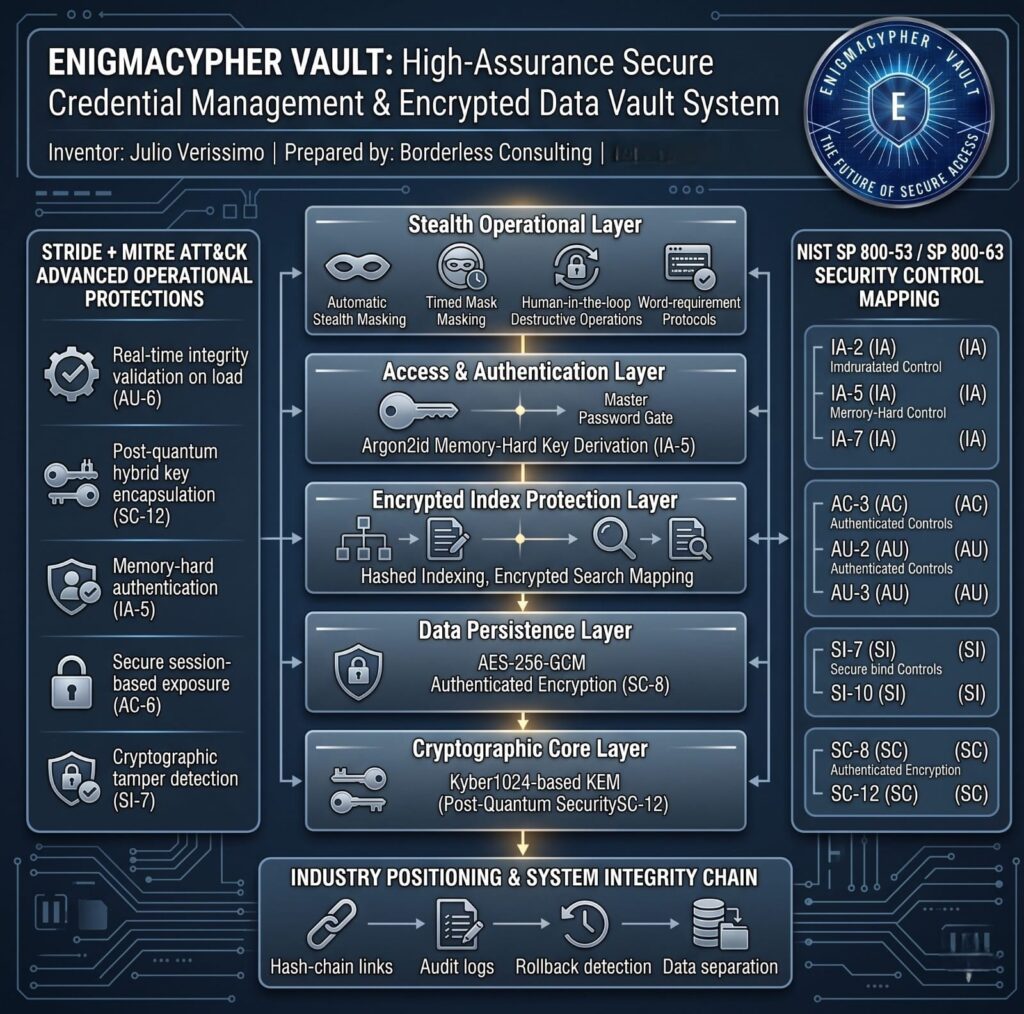
📊 NIST SP 800-53 / SP 800-63 CONTROL MAPPING
This mapping represents a structured alignment of implemented security functions to NIST SP 800-53 and SP 800-63 control families for reference purposes.
🔑 IDENTIFICATION & AUTHENTICATION (IA)
- IA-2: Authentication control implemented via master credential model
- IA-5: Authenticator lifecycle supported via Argon2id-derived secrets
- IA-7: Cryptographic authentication supported via HMAC integrity verification
- IA-8: Local authentication model (offline secure vault execution)
🔐 ACCESS CONTROL (AC)
- AC-3: Enforced authentication before access
- AC-6: Least privilege exposure of sensitive data
- AC-7: Controlled authentication failure handling
- AC-1: Structured access control policy design
🧾 AUDIT & ACCOUNTABILITY (AU)
- AU-2: Event logging (vault operations tracking)
- AU-3: Integrity record content via hash-chain
- AU-6: Automated integrity validation
- AU-9: Protection of audit-relevant cryptographic metadata
🧱 SYSTEM INTEGRITY (SI)
- SI-7: SHA-256 cryptographic integrity chain
- SI-10: Controlled input validation
- SI-12: HMAC-based authentication verification
- SI-16: Memory protection (best-effort secure wipe)
🔒 SYSTEM & COMMUNICATION PROTECTION (SC)
- SC-8: AES-256-GCM encryption providing confidentiality and integrity
- SC-12: Post-quantum key encapsulation implemented via Kyber-based mechanism
- SC-13: Hybrid cryptographic protection model
- SC-28: Encryption of data at rest using AES-256-GCM mechanisms
- SC-39: Separation of cryptographic and indexing layers
⚙️ CONFIGURATION MANAGEMENT (CM)
- CM-2: Version-controlled vault schema (V9 architecture)
- CM-6: Controlled system configuration parameters
- CM-7: Reduced attack surface design principle
🔄 CONTINGENCY PLANNING (CP)
- CP-6: Encrypted local persistence model
- CP-9: Secure backup via encrypted vault storage
- CP-10: Integrity-verified recovery process
⚠️ RISK ASSESSMENT (RA)
- RA-2: High-confidentiality system classification
- RA-3: Multi-layer cryptographic risk mitigation
- RA-5: Continuous integrity validation mechanisms
🧠 THREAT MODEL ANALYSIS
STRIDE + MITRE ATT&CK ADVERSARY SIMULATION
🧩 STRIDE THREAT MODEL
🔴 S — Spoofing
Threat scenario: Impersonation of an authorized user
Mitigation:
- Master password authentication (Argon2id hardened)
- Cryptographic key binding (HMAC + AES-GCM)
- Local-only authentication context
🔴 T — Tampering
Threat: Modification of vault data or stored credentials
Mitigation:
- HMAC-SHA256 integrity verification
- SHA-256 hash-chain validation
- AES-GCM authenticated encryption prevents ciphertext manipulation
🔴 R — Repudiation
Threat: Denial of actions performed
Mitigation:
- Timestamped vault events
- Hash-chain traceability of operations
- Immutable encrypted state transitions
🔴 I — Information Disclosure
Threat: Exposure of stored credentials
Mitigation:
- Full AES-256-GCM encryption at rest
- Stealth display mode with timed masking
- Memory-hard key derivation (Argon2id)
- Encrypted index abstraction layer
🔴 D — Denial of Service
Threat: Vault corruption or access disruption
Mitigation:
- Integrity validation before load
- Failure-safe abort on tampering detection
- Local deterministic recovery model
🔴 E — Elevation of Privilege
Threat: Unauthorized access escalation
Mitigation:
- Master password gate for all sensitive operations
- Dual-step deletion confirmation
- No privilege escalation pathways in design
🧠 MITRE ATT&CK ADVERSARY SIMULATION
🎯 INITIAL ACCESS
- Brute-force password attempts
→ Mitigated by Argon2id memory-hard derivation - Credential stuffing
→ Mitigated by cryptographic key binding + salt isolation
🎯 EXECUTION
- Malicious local execution attempts
→ Mitigated by offline-only vault architecture
🎯 PERSISTENCE
- Vault file manipulation
→ Mitigated by HMAC + hash-chain integrity enforcement
🎯 PRIVILEGE ESCALATION
- Attempted bypass of authentication
→ Mitigated by mandatory master key verification
🎯 DEFENSE EVASION
- Stealth inspection of decrypted memory
→ Mitigated by timed exposure + automatic masking
🎯 CREDENTIAL ACCESS
- Memory scraping attacks
→ Mitigated by ephemeral password display model
🎯 COLLECTION
- Vault extraction attempts
→ Mitigated by full AES-256-GCM encryption at rest
🎯 IMPACT
- Vault destruction or rollback attempts
→ Mitigated by hash-chain integrity + rollback detection
🧠 SECURITY DESIGN PRINCIPLES
- Zero Trust Architecture (ZTA) Model
- Defense-in-Depth Security Strategy
- Least Privilege Data Exposure
- Ephemeral Sensitive Data Display
- Human-in-the-loop destructive operations
- Cryptographic forward secrecy assumptions
- Tamper-evident storage model
- Post-quantum readiness architecture
Enigma Cypher Vault, developed by Borderless Consulting, represents a high-assurance cryptographic security system combining classical encryption, authenticated encryption standards, memory-hard authentication, and post-quantum cryptographic readiness principles.
The system is designed with reference to NIST SP 800-53 and SP 800-63 security control frameworks, incorporating applicable security principles, integrating structured compliance mapping and adversarial threat modeling using STRIDE and MITRE ATT&CK methodologies.
It is designed for environments requiring:
- High confidentiality protection
- Integrity assurance at all system levels
- Controlled access and authentication enforcement
- Resistance against modern and emerging threat models
- Cryptographic modernization readiness
This document does not claim certification, regulatory approval, or formal validation under any security or compliance standard.
EnigmaCypher products



Check EnygmaCypher Encryptor™. EnigmaCypher is a branded label of Borderless Consulting